Benefits of natural lighting
As already mentioned in previous articles, there are several benefits brought byindustrial natural lighting, including energy savings and the impact on health and a sense of well-being.
It is also worth remembering that natural lighting can be vital for the proper functioning of the industrial environment, and this includes energy efficiency, sustainability and cost reduction, all in the face of an increasingly expensive input, electricity.
On the other hand, there are points that require attention. For example, the problem of heating when sunlight is used, that is, the challenge of ensuring the use of natural light avoiding heat accumulation inside the building.
Natural lighting in industry and thermal comfort
In addition to all these advantages, natural lighting also brings more news with a growing interest in the application of natural ventilation in industry, mainly in the issue of thermal comfort, which describes how satisfied an occupant is in a given space.With regard to industry, thermal comfort is not only related to the feeling of well-being, but has a direct impact on productivity, as indicated in this graph, which is the result of aNASA performance study, the North American space agency, on the subject:

There are several ways to measure thermal comfort: the most common of them is air temperature. Others consider radiant temperature and humidity, air movement, and even the type of clothing people are wearing.
In a more practical example, let's think of a room that seeks thermal comfort through artificial air conditioning, using air conditioning for example. It is well known that this is a major contributor to energy consumption, and in fact we do not even have a guarantee that thermal comfort will be successfully achieved.
And since we're talking about more natural alternatives, what would be a good option?
The best solution, especially in buildings with large glazed facades, is to have allies such as brises to limit the incidence of sunlight, or industrial warehouses, clerestory windows and shutters to improve air circulation.
Below we will explain each of these solutions.
The brises

These are elements used to minimize the direct incidence of sunlight on the building, in order to make shading of facades possible, for example.
When we think about an application of brise windows to shade facades, we have them at points of more critical insolation, precisely to control the internal temperature. The idea of the panels is to protect from the sun, maintaining good visibility to the outside, while promoting shading and ventilation of the facade.
Industrial Lanterns and Shutters
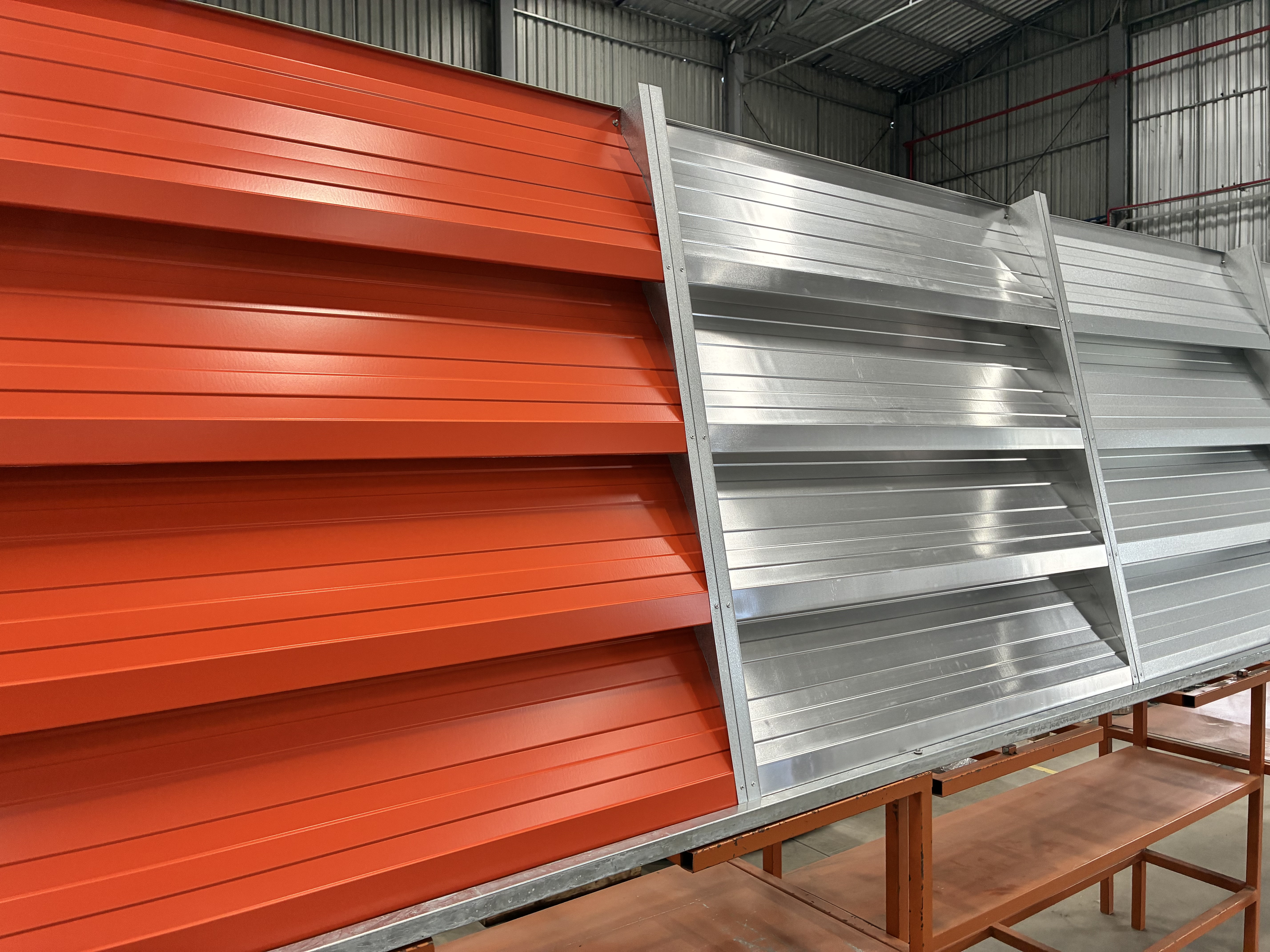
Another solution, much more common in industrial buildings, is thecreation of natural and constant air circulation, through the use of louvers and industrial shutters. In addition to ensuring internal air renewal and temperature control, the system also favorsnatural lighting. In addition to these, there is also the use of louvers, which allow accumulated hot air to be expelled through the roof, generating a continuous current.
The domus

The domus – like theMB Group Linealight– are among the most recent and innovative technologies in natural lighting. Its principle is to use sunlight in the most efficient and safe way possible, so that the use of artificial lighting can even be completely eliminated during several hours of the day, even on cloudy days.
These domes are a very interesting option for industrial natural lighting due to their high light transmission and great refraction capacity – using ideal materials, as we will see later, which greatly expands the illuminated area in the environment, extending well beyond the area immediately below the domus.
MB Group Solutions
The MB Group has products (for industrial warehouses) that offer solutions combined with efficient natural lighting and thermal comfort, based on the materials used.
These materials are polycarbonate prismatic and polycarbonate alveolar. We have already written more detailed information about these materials:
- Read more: Prismatic polycarbonate in natural lighting: what is the advantage
- Read more: The use of honeycomb polycarbonate in natural lighting in industry
In general, these are the particularities of these materials:
Alveolar polycarbonate, The difference in its structure is the incidence of hollow cavities (alveoli), which can be simple or double. The reason for these cavities is to considerably reduce the weight and amount of material needed to manufacture it.
Prismatic polycarbonate It contains a large number of microprisms, which refract sunlight with great efficiency. In addition to efficiently intensified lighting, these materials have:
- The great characteristics of polycarbonate. Far superior to glass and acrylic in lightness, durability, resistance to impacts and yellowing;
- Good light diffusion. Homogeneous, uniform and diffuse natural lighting;
- Good thermal control. Retains much of the heat, ensuring the thermal comfort of the industrial natural lighting system
- Blocking up to 90%of ultraviolet (UV) radiation.

To find out more about MB Group’s natural lighting and ventilation solutions for Industry, Download our complete catalog with all the technical information on our linear domes, lanterns and industrial shutters, or contact us using the form below torequest a quote within 3 business days.