Let's talk about the benefits of using linear domes for natural lighting in the industry, focusingin the materials of each model e how to choose the best option for your factory.
Linear domes and natural lighting in industry
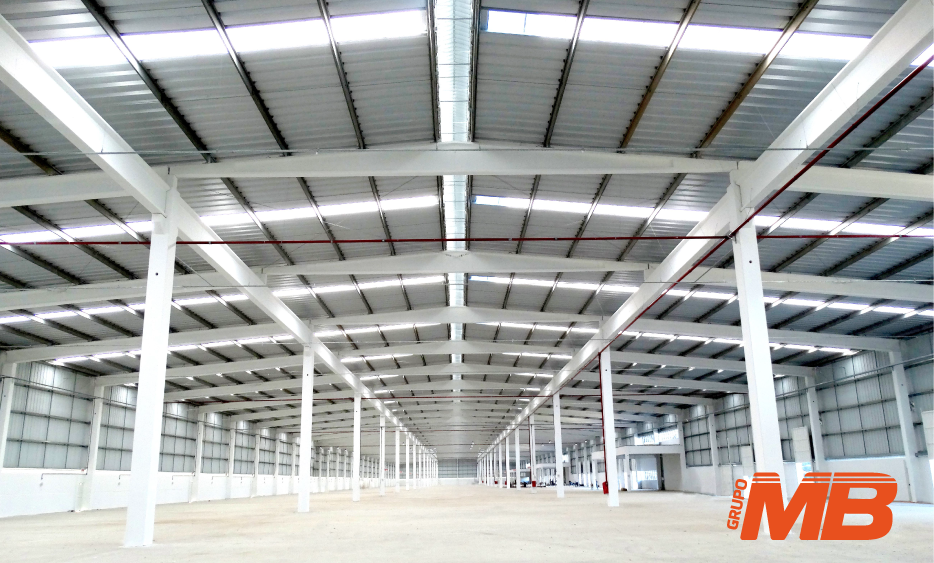
Linear domus are extremely important architectural structures in industrial civil construction. Its useallows lighting up to 8 times more than windows with equivalent opening area. It is a linear, continuous opening in the roof of a space, from a warehouse to an office, that allows air and/or light to enter.

Its main function in the industry is as a natural lighting element. Electrical energy is one of the most important inputs and, in some sectors, correspondsmost of the production cost.
When well designed, linear domes provide a series of advantages for the internal environment and for the company:
- Reduction in energy bills by reducing the use of lighting fixtures;
- Improving employee well-being with a more comfortable environment;
- It adds to the commitment to sustainability, as it is a simple, efficient method with an important impact on the environment and the reduction of energy consumption.
In industry, where work in large warehouses is common, the use of linear domes has an even greater impact.

However, it is necessary to choose the right model for each structure. There are several different models and materials used in the manufacture of linear domes. The characteristics of the warehouse or factory, as well as the company's financial availability, will determine the best choice.
Linear domus in industry
O linear domusIt is a flexible option and can be easily adapted to any type of coverage in order to make the best use of natural light. In fact, a term you will hear mentioned is zenithal lighting. This is the lighting obtained through openings in the roof of a building (Domus), as opposed to that obtained with lateral lighting (windows).
Read more: Zenith lighting and ventilation for factories and large warehouses
To enjoy the benefits of the linear domus, you need to know the materials and model variations available. The material used in each model is mainly responsible for quality and price variation.
There are three main materials:fiberglass, acrylicand thepolycarbonate, in two variations:prismatic e alveolar.
[sc name=”form-guia-iluminacao-natural” ]
Fiberglass
Fiberglass is a plastic material reinforced with thin filaments of glass. Its main quality is good mechanical resistance. However, two disadvantages are the fact that it isflammableand yourlow light transparency. Therefore, it is not the best option if the objective is to maximize natural lighting. But depending on the available budget, the price can make this option interesting compared to other more expensive ones.
Acrylic
Linear domes made with this material do not have the same mechanical resistance as fiberglass, but they provide better quality lighting. It is also flammable and has an additional problem which is the higher level of ultraviolet ray transmission (40%, while fiberglass is 20%).
Both fiberglass and acrylic are recommended for projects with a more limited budget, as they do not bring together all the best characteristics desired for an optimal natural lighting structure.
Polycarbonate
Polycarbonate is the highest quality option, and also the highest cost. In this case, the price is not necessarily a good evaluation parameter, as with a higher quality linear domus, the return on investment is also faster.
There are two variations of polycarbonate applied to MB Group domes: prismatic and honeycomb.
Prismatic Polycarbonate
In the case of prismatic linear domes, the big difference is the tiny microprisms with great refraction capacity that are introduced in large quantities into the polycarbonate (26 thousand per m2).
Prismatic linear domes illuminate a larger area of the room, not just the one immediately below them. Another advantage is the blocking of ultraviolet rays. More than 90% do not pass prismatic polycarbonate. It is non-flammable and has good flexibility.
If you are looking for total efficiency, check out the article “Prismatic polycarbonate for natural lighting” and find out more.

Alveolar polycarbonate
Alveolar polycarbonate is similar to corrugated glass, as it is made up of a sheet with special internal cells (alveoli). This characteristic provides high resistance to impacts and, at the same time, high flexibility. It is more versatile than the prismatic model and easily adapts to any structure.

To learn more about its use see:Alveolar polycarbonate and natural lighting.
The linear domus, whether honeycombed or prismatic, is the best option in terms of cost-benefit and maximizing natural lighting. The reduction in energy bills and the internal quality of the environment are better with models that use these materials.
What is the best option for your case? Depends on local characteristics, available budget and minimum investment criteriaPayback and Return on investment.
Now that you know the materials and the advantages of each one, how about getting to know the MB Group catalog of natural lighting and ventilation solutions for industry? Here you will find all the specifications and techniques and data on the best solutions for natural lighting.