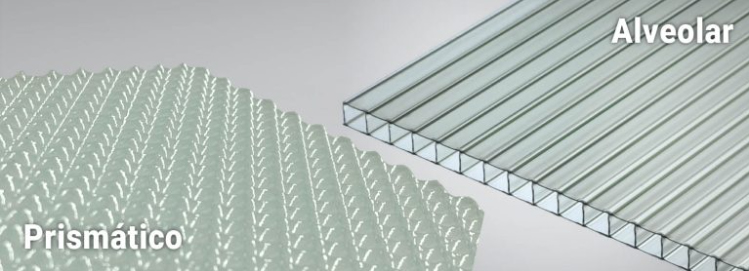
Domus Alveolar and Domus Prismático are terms that refer to Domus Linealight, a system that allowsmake better use of natural lighting in an environment. The difference between them is in their composition, according to the type of polycarbonate used.
Furthermore, theLinear Domusoffer great advantages for industrial warehouses, as their main objective is to improve the lighting of the internal environment.
Whatever your choice, the truth is that both the Alveolar Domus and the Prismatic Domus offerexcellent results for the industry, as they promote asignificant savings due to natural lighting.
In this content, we will explain the difference between these two materials and show which one to choose. Understand more.
Comparison between Alveolar Domus and Prismatic Domus
The Alveolar Domus and the Prismatic Domus are widely used in industry. These systems provide aquality natural lighting for up to eight hours a day, thus eliminating the need for lamps.
This is important due to the increase in electricity bills. To give you an idea, the increase was greater than double inflation in 2021, according to data fromBrazilian Association of Energy Traders (Abraceel). The increase was 114% in 2021 alone. In the same period, inflation grew 48%.
Furthermore, when manufactured correctly, the materials are highly resistant. Installation is simple and can be done on any tile model using adjustable clips.
Therefore, the sheets ofDomusconstitute the ideal alternative to achieve thebest performance with maximum cost reduction and greatest sustainability potential.
Enjoy anddownload this e-book with a comparison between industrial lighting systems.
Despite being materials with the same objective, Domus Alveolar and Domus Prismático are different. Therefore, it is important to understand its characteristics.
Before explaining how to select the most suitable one for your project, it is worth knowing that Domus Alveolares are full of alveoli, that is, small hollow spaces inside the material.
They favor the refraction of light. Furthermore, they are80% lighter and 250 times stronger than glass. Therefore, they provide a series of benefits to industrial warehouses. For example:
- Greater lightness;
- Lower cost;
- Better temperature control (the spaces in the alveoli contain air, which is a good thermal insulator, especially in milky white and reflective polycarbonates).
For more information about honeycomb polycarbonate, be sure tocheck out the article: Honeycomb polycarbonate and natural lighting.
In turn, the Prismatic Domuses have a structure with 26 thousand microprisms. Theyensure the propagation of natural light more efficiently. They also provide a series of advantages, such as:
- High light transmission rate;
- High rate of solar reflection;
- Very high refraction and light diffusion capacity.
The aspect of light diffusion really deserves to be highlighted. This is because the Prismatic Domus does this with enormous effectiveness, illuminating an area far beyond that immediately below the Domus.
For more information about the Prismatic Domus, be sure to check outthis article.
Alveolar Domus and Prismatic Domus: which one to choose
As highlighted, Domus sheets are made of polycarbonate. However, the composition of each of them is different. In any case, these materials offerwide spread of light,which already adds many advantages to the product.
Furthermore, another important benefit is the 5-year warranty on polycarbonate. These materials require cleaning from time to time just to ensure the Domus’ ability to transmit natural light.
So how to choose? The distinction must consider, in addition to cost, specific properties of the building structure and the need for lighting.
Polycarbonate and its use in natural industrial lighting
Polycarbonate is a material with very interesting and reliable properties when used in various products, including, in addition toDomus, covers and shutters. It still has great advantages over other materials, such as glass, PVC, acrylic and fiberglass, asthis article.
Some of the properties that highlight the advantages of its use are:
- Resistance;
- Self-extinguishing;
- Flexibility;
- Durability;
- Resistance to yellowing;
- Guarantee of tightness, that is, there is no cracks, holes and porosities;
- Visual comfort;
- UV protection;
- Finish in the color of the tile;
- Low specific weight;
- Lighting uniformity;
- 70% light transmission in the prismatic polycarbonate sheet.
These qualities are very interesting forguarantee a return on your investmentand guarantee excellent value for money. Furthermore, polycarbonate can be made in different ways, as we explained.
O MB Groupis a specialist in this solution and works with Domus Alveolar and Domus Prismático. We even help define the best alternative, as we use cutting-edge technologies for this purpose.
Additionally, we offer theMB Smart, a system that manages all lighting resources intelligently. This ensures that the industry has thebest performance with lowest energy consumption. It is an extra next to the Domus Linealight, and is also a success story.
You can even have a personalized light mechanism, in order to guarantee greater luminosity for those sectors that present this demand. Therefore, it is a measure tocombining cost reduction and sustainability.
Now you know how these solutions work. After all, Domus Alveolar and Domus Prismático are beneficial for the industry, but you need to think about the needs of your project before defining the ideal. This way, you get to the right answer.
So, how about finding out more about DomusGet in touch with Grupo MBand take the opportunity to check out ourcatalog of natural lighting and ventilation solutions for industry.