In metal roofs with zipped tiles, the definition of natural lighting elements needs to be treated as a technical decision integrated into the system and not as an adaptation made in the field.
More than choosing between solutions, it is essential to understandwhat should not be done, especially when we talk about the integrity of the roof. This is because the zipped tile was not designed to undergo interventions such as cuts or perforations.
What is seam tile and why does it require a technical approach in the specification
Zip tile is a continuous metal roofing system, designed to eliminate perforations and ensure greater watertightness over time. Unlike conventional systems, it is fixed using hidden clips and mechanical closure between panels, which allows the roof to work in an integrated manner, absorbing structural movements and thermal variations without compromising sealing.
This type of solution is widely used in industrial projects precisely because of its ability to offer greater durability, less need for maintenance and better performance against bad weather. By maintaining the continuity of the surface, the zipped tile favors the natural flow of water and significantly reduces critical infiltration points.
👉 In practice, this guarantees:
- continuous, perforation-free coverage
- greater tightness over time
- better response to thermal expansion
- lower risk of execution failures
- greater performance predictability
This means thatany cut directly compromises system performance. When the tile is cut on site, exactly what makes it superior is lost:
- continuity
- seal
- durability
How water runoff influences roof performance
The behavior of water on metal roofs is directly linked to the continuity of the surface and the absence of interference in the flow plane. In systems with zipped tiles, this flow is conducted naturally from the ridge to the gutter, as long as the roof maintains its constructive integrity.
When this pattern is preserved, the system operates predictably, reducing retention points and avoiding localized overload. However, when introducing specific elements, this behavior is changed and becomes dependent on deviations in the natural flow.
👉 In practice, this generates:
- interruption of water flow
- formation of retention zones
- increased exposure time to humidity
- increased request regarding sealing points
- concentration of hydraulic efforts
Why it is NOT recommended to cut seam tiles on site?
Cuts in zip tiles are one of the main causes of premature failures in industrial roofing.
Main technical impacts:
1. Risk of corrosion and oxidation
Cutting exposes the metal, drastically reducing its lifespan.
2. Loss of tightness
The zipped tile works as a “sewn” system. When cutting, gaps appear that facilitate infiltration.
3. Damage to the tile profile
Deformations compromise the fit and sealing.
4. Loss of warranty
Interventions in the field may invalidate the performance predicted by the manufacturer.
5. Accumulation of metallic waste
Particles accelerate corrosive processes in the roof.
In short: cutting zipped tiles distorts the system.
Thermal expansion: a critical point ignored in point solutions
Metal roofs undergo expansion and contraction daily. In zipped tiles, this movement is predicted and absorbed by the system.
When there are cutouts or interference:
- tension concentration points appear
- there is overload in specific regions
- increases material fatigue
The problem is not dilation, it is when the system is no longer able to absorb it correctly.
The correct way to work with natural lighting in zipped tiles is not to adapt, it is to integrate.
Domus Linealight MB: continuity as a design premise
O MB Group Domus, was developed to act in an integrated manner with the construction logic of metal roofs, especially in systems with zipped tiles, where surface continuity is crucial to performance. Instead of introducing multiple interferences, the solution works continuously, with the following characteristics:
- there is no cutout in the tile
- there is no perforation
- complete replacement of a tile by a domus line
This guarantees:
- perfect fit to the zipped system
- maintaining continuity of coverage
- preservation of tightness
In addition to constructive integration, Domus Linealight was designed to enhance natural lighting in the industrial environment, directly contributing to reducing the use of artificial lighting and, consequently, to gains in energy efficiency.
Technical Difference:
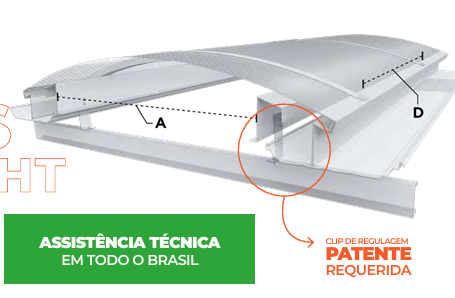
Unlike solutions that ignore or concentrate these efforts, linear domuses were designed with a patented clip system that allows controlled movement between the tile and the domus. This makes it possible to naturally absorb thermal expansion caused by exposure to the sun, without generating localized tensions in the system. As a result, there is a significant reduction in concentrated efforts, maintenance of tightness over time and a consistent increase in the durability of the roof as a whole.
In practice, it is a solution that balances technical performance and system efficiency: it maintains the integrity of the roof, reduces execution variables and improves internal lighting conditions, without compromising the constructive logic of the project.
👉 In summary, theDomus Linealightprovides:
- continuous application throughout coverage
- less interference with the seam tile
- reduction of critical sealing interfaces
- high durability and resistance in industrial environments
- direct contribution to energy efficiency
- ability to absorb thermal expansion
- patented clip system
Consolidated technical comparison
The difference between a punctual dome and a linear dome is not just in the format or application, but mainly in the impact that each solution generates on the behavior of the roof as a continuous system.
While the punctual domus introduces multiple interferences along the tile, the MB Group's linear domus was developed to preserve the construction logic, reducing variables and increasing performance predictability.
👉 Comparing directly:
| Criterion | Domus Pontual | Domus (Linealight) |
|---|---|---|
| Roof application | Punctual (fragmented) | Continuous |
| Interference with zipped tile | High (multiple cuts) | Low |
| Number of interfaces | High | Reduced |
| Water runoff | Interrupted | Preserved |
| Need for maintenance | Bigger | Reduced |
| Energy efficiency | Limited | High (better use of light) |
| Thermal expansion | Tension points | Absorbed by clips |
How to correctly specify the system
Designing industrial roofs requires a systemic vision. The choice of the domus must consider not only the lighting function, but its interaction with the roof.
👉 Before specifying, evaluate:
- whether there will be a cutout in the tile
- the impact on continuity
- the number of interfaces generated
- the behavior of thermal expansion
👉 If there is a cut, the path is already wrong.
Same design, completely different behaviors
In the same client, two scenarios clearly showed how the choice of solution directly influences coverage performance. In the first shed, specific domes were specified distributed along the zipped tile.
Initially, the solution met the need for natural lighting. However, over time, failures associated with the multiple interfaces created in the coverage began to appear. These failures were not concentrated in a single point, but distributed throughout the regions where there was intervention.
👉 This scenario presented:
- several cutouts in the zipped tile
- increasing the number of sealing interfaces
- greater dependence on the quality of execution
- loss of tightness in isolated points
- need for corrective interventions
Based on this history, the specification was revised with a more systemic approach. The solution began to consider the coverage behavior as a whole, resulting in the adoption ofMB Group linear domus, prioritizing continuity, less interference and greater technical control.
FAQ
Point domus can be used on zipped tiles
Yes, but it compromises the tightness of the cover. Choose another model.
What is the main advantage of the linear domus
Preserve the continuity of coverage, eliminating the need for cutting, drilling and reducing interference in the system.
It is necessary to cut the zipped tile to install domus
No. In correct solutions, such as the linear domus, installation occurs by completely replacing the tile, without cutting or drilling.
What is the best natural lighting solution for zipped tiles?
The best solution is one that preserves the continuity of the roof and does not require cutting or drilling into the tile. In this context, the linear domus stands out for replacing the tile completely, maintaining watertightness, respecting thermal expansion and ensuring greater predictability of performance over time.
The linear domus needs frequent maintenance
Yes, just cleaning the lenses. By reducing interfaces and respecting the logic of the zipped tile, the need for technical maintenance is significantly lower. Therefore, it only requires frequent cleaning maintenance with water and neutral soap.
Conclusion
The choice between a point dome and a linear dome directly impacts the behavior of the metal roof, especially in systems with zipped tiles, where continuity and integration are critical factors.
Preserving constructive logic, reducing interfaces and ensuring execution predictability are fundamental elements for a well-specified project.
In this scenario, theMB Group Domusis positioned as a coherent solution from a technical point of view, aligned with the requirements of those who design and execute it.
👉 Speak to Grupo MB and evaluate the most suitable solution for your project.