In projects ofindustrial retrofit, ventilation and natural lighting are not just decisions related to thermal comfort. These are decisions that directly impact OPEX (Operational Expenditure), energy efficiency and the predictability of operation costs over the years.
When properly sized, considering the air renewal rate, average lux required and regulatory requirements, these solutions reduce energy consumption, corrective maintenance and dependence on mechanical systems.
Why ventilation and lighting directly impact OPEX
In industrial warehouses, three factors strongly impact operating costs:
- Energy consumption with air conditioning
- Energy consumption with artificial lighting
- Recurring maintenance of mechanical equipment
NR 15 and NR 17 already indicate parameters related to thermal comfort and environmental conditions suitable for work. Furthermore, technical recommendations for air renewal and average illuminance levels (average lux) are crucial for productivity and safety.
When the environment does not reach adequate levels of air renewal or depends exclusively on mechanical air conditioning, the impact appears on energy bills and maintenance.
Smart retrofit is to reduce mechanical dependence and increase passive efficiency.
Technical comparison: strategic replacements in industrial retrofit
In industrial retrofit, replacing conventional systems with well-designed natural solutions is not just modernization, it is operational cost restructuring.
Below, the four most relevant replacements from a technical and financial perspective.
1. Wind Exhaust Fans vs Lanternim MB
Traditional system: Wind exhausters
- Direct dependence on external wind speed
- Variable and non-predictable air flow
- Presence of moving parts → mechanical wear
- Does not allow scaling with calculation memory
- Does not guarantee minimum air exchange rate per hour
- Limited exhaust capacity in environments with high thermal load
Natural ventilation: Lanternim MB
- Operation based onchimney effect Venturi effect
- Aerodynamic geometry for airflow acceleration
- No moving parts → zero mechanical maintenance
- Possibility of damper to close the ridge
- Anti-insect and anti-bird screens
- Tightness guarantee
- Sizing with calculation memory according to industrial activity
- Models with opening up to 2005 mm
- Structural weight calculated per linear meter (up to 145 kg/ml)
Financial impact of the decision:
By replacing energy-dependent systems with dimensioned natural ventilation, the company reduces structural thermal load, eliminates recurring mechanical maintenance and reduces dependence on active air conditioning.
It is the exchange of a variable and unpredictable cost for permanent efficiency in OPEX.
2. Conventional Translucent Tile vs Domus Linealight
Conventional solution: Translucent tiles
- Uncontrolled light transmission
- Spot and uneven lighting
- No internal thermal barrier
- Tendency to yellowing and loss of performance
- Does not necessarily meet minimum illuminance levels according to NBR ISO 8995
- Variable IRC
Natural lighting: Domus Linealight
- Meets NBR ISO 8995 (minimum industrial illuminance levels)
- Uniform and continuous lighting
- Prismatic models with up to 70% light transmission
- Double lens (LD system) with air chamber (~150 mm) acting as a thermal barrier
- Average reduction in lamp use by up to 8 hours/day
Financial impact of the decision:
With uniform natural lighting and thermal control, Domus reduces the use of lamps for up to 8 hours/day and reduces heat gain on the roof.
In practice, this means recurring energy savings and a consistent reduction in operating costs over time.
3. Continuous air conditioning vs Industrial Venetian blinds
Conventional system: Mechanical air conditioning
- Continuous high energy consumption
- Recurring maintenance
- Total energy dependence
- Does not reduce the structural thermal load of the building
- Does not act on natural air renewal
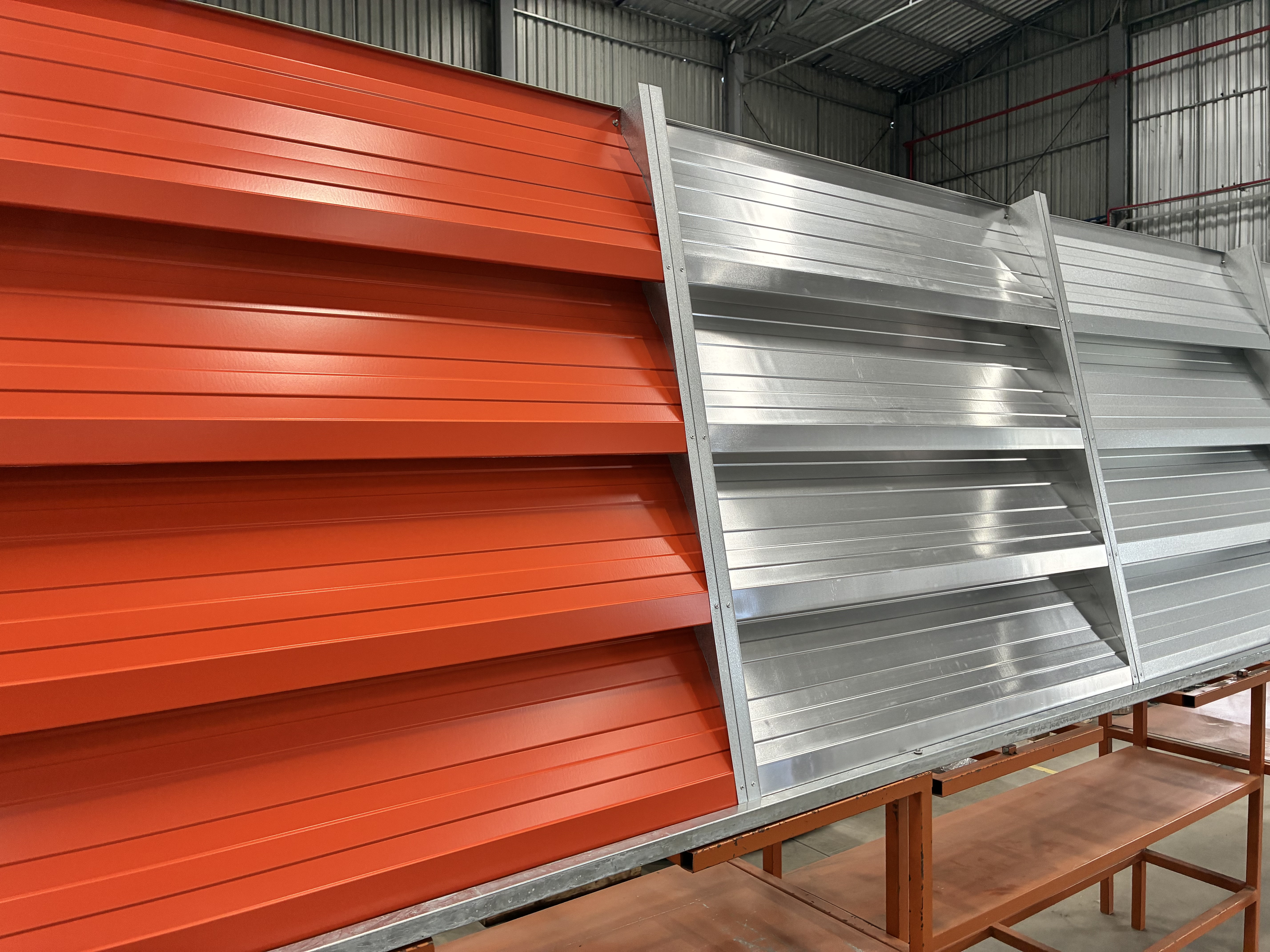
Natural Ventilation: MB Industrial Venetian blinds
- Side ventilation with infiltration control
- Manual or automated activation
- Thermal load reduction
- Complementation of zenithal exhaust
- Air intake control according to operational needs
Financial impact of the decision:
By reducing the thermal load before it requires mechanical intervention, the company reduces air conditioner operating time, increases the useful life of the equipment and reduces annual maintenance costs.
Less active energy, less wear, less operational risk.
4. 100% Active Conventional Lighting vs Integrated MB Smart
Conventional system
- Luminaires operating at full power throughout the shift
- Lack of natural light reading
- No consumption reports
- No intelligent sectorization
Integrated System: MB Smart Domus
- Automatic dimming according to solar incidence
- Continuous performance reports
- Remote monitoring
- Integration with existing lighting systems
- Intelligent light load management
- Energy optimization aligned with the 2030 Agenda (SDG)
Financial impact of the decision:
Automation eliminates overlighting and energy waste, transforming natural light into a direct reduction in electrical consumption.
It's not just control, it's strategic energy management.
How much can you save on an industrial warehouse
The economy depends on:
- Shed area
- Activity carried out
- Internal thermal load
- Operating hours
- Geographic location
In retrofit projects where conventional systems are replaced by well-designed natural solutions, it is possible to observe:
- Gradual reduction in energy consumption
- Lower maintenance frequency
- Increased service life of auxiliary equipment
Real cases, such as the Koch network, demonstrate that the adoption of integrated natural solutions can generate measurable operational gains, especially in large units.
In this case, approximately 15,000 luminaires were automated with the integration between Domus Linealight and MB Smart, generating annual savings of R$1,674,000.00.
This result shows that it is not just a technical or aesthetic improvement in the building, but a decision with a direct impact on the financial result of the operation and strategic energy management.
When is it worth replacing conventional systems
The switch must happen at a time when costs begin to escalate faster than the efficiency of the operation. If energy rises, maintenance is repeated and thermal discomfort starts to affect productivity, the challenge ceases to be operational and starts to compromise profitability.
This movement normally appears when:
- Energy costs rise above the business average
- Equipment requires constant maintenance
- Heat impacts performance and production quality
- The company approaches regulatory or labor limits
- Are there plans for expansion or modernization
- The board establishes clear OPEX reduction targets
For those who want to optimize the operation, timing is strategic.
Each month maintaining inefficient systems means wasted energy, accumulated wear and tear and compressed margin
Conclusion
Ventilation and natural lighting, when technically dimensioned, are no longer just architectural elements and start to act as direct cost management tools.
By reducing dependence on mechanical systems, improving air renewal and intelligently taking advantage of natural lighting, the operation reduces its structural energy load and gains continuous efficiency.
The impact is clear: less waste, less pressure on OPEX and greater financial predictability.
A well-informed decision today translates into recurring savings and sustainable competitiveness in the coming years.
Your operation may cost less
Calculate the cost reduction potential of your operation right now.
Talk to Grupo MB and evaluate how natural solutions can transform your industrial retrofit into a long-term financial asset.